

Answers to common technical and operational questions regarding valve selection, installation, and maintenance
The test pressure for the body of general-purpose valves is 1.5 times the rated working pressure of the material at 38°C. The high-pressure seal test is conducted at 1.1 times the rated working pressure of the material at 38°C. Requirements for low-pressure seal tests vary by standard.
Specifically:
GB/T 13927-1992, ISO 5208:2008, and EN 12266.2-2012 specify 0.6 MPa ± 0.01 MPa;
GB/T 26481-2011 and API 598-2009: 0.4 MPa to 0.7 MPa;
MSS SP61-2013: 0.56 MPa;
API 6D-2014: Type I: 0.034 MPa to 0.1 MPa; Type II: 0.55 MPa ± 0.69 MPa;
ISO 14313:2007: Type I: 0.05 MPa to 0.1 MPa; Type II: 0.55 MPa ± 0.07 MPa;
API 6A (equivalent to ISO 10423:2003): For PSL 3G, first test: rated pressure; second test: 2.0 MPa ± 0.2 MPa; for PSL 4, first test: rated pressure; second test: 2.0 MPa ± 0.2 MPa.
Project | Operating Temperature |
High-Temperature Valves | Operating temperature of the medium exceeds 450°C |
Heat-Resistant Valves | The operating temperature of the medium is above 600°C |
Low-Temperature Valves | Operating temperature range: –29°C to –100°C |
Cryogenic Valves | Operating temperature of the medium is less than –100°C |
Project | Nominal Size |
Extra-Large-Bore Valves | DN≥1400mm |
Large-Bore Valves | DN350mm~1200mm |
Medium-Bore Valves | DN50mm~300mm |
Small-Bore Valves | DN≤40mm |
Project | Nominal Pressure |
Ultra-High-Pressure Valves | PN≥100MPa |
High-Pressure Valves | PN10.0MPa~80.0MPa |
Medium-Pressure Valves | PN2.5MPa~6.4MPa |
Low-Pressure Valves | PN≤1.6MPa |
Classification of valves by application or primary structural features.
The general classification system, which categorizes valves based on both principle and function as well as structure, is currently the most widely used classification method both domestically and internationally. Valves are generally classified into the following types: gate valves, globe valves, plug valves, ball valves, butterfly valves, diaphragm valves, check valves, throttle valves, safety valves, pressure-reducing valves, steam traps, and control valves.
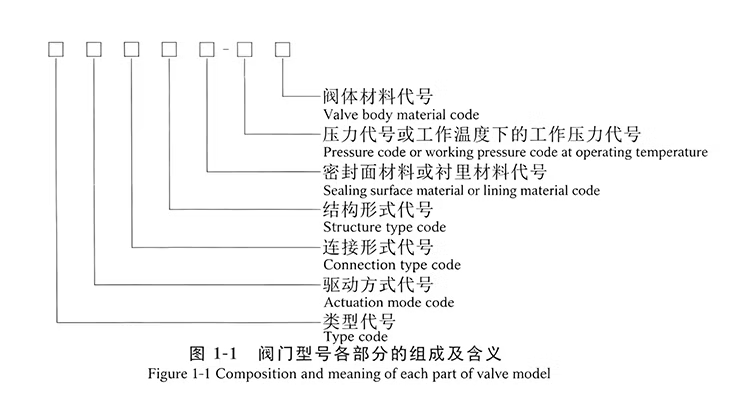
Valve model numbers are composed of codes representing the valve type, actuation method, connection type, construction type, sealing surface material or lining material type, pressure rating or operating pressure at the specified temperature, and body material.
The valve model consists of seven parts, the meanings of which are shown in the figure.
NPS:
A dimensional designation consisting of a combination of letters and numbers used for piping system components, comprising the letters “NPS” followed by a dimensionless integer. This number is directly related to characteristic dimensions such as the bore diameter or outside diameter of the end connection. The dimensionless number may be used as a valve size designation without the “NPS” prefix. The dimensionless number does not represent a measured value and should not be used in calculations.
Class:
A designation consisting of a combination of letters and numbers that relates to the mechanical properties and dimensional characteristics of valve materials and indicates the pressure/temperature capabilities of the valve. It consists of the letter “Class” followed by a dimensionless integer. The number following the letter “Class” does not represent a measured value and should not be used in calculations. Unless otherwise specified in the relevant standards, the allowable pressure of piping components depends on the Class value, the material, and the permissible operating temperature. The allowable pressure is specified in the pressure-temperature rating tables of the corresponding standards.
DN:
A dimensional designation consisting of a combination of letters and numbers used for components in piping systems. It consists of the letters “DN” followed by a dimensionless integer. This number is directly related to characteristic dimensions such as the bore diameter or outer diameter (expressed in mm) of the end fitting.
Note:
PN:
An identification code consisting of a combination of letters and numbers used for reference, related to the mechanical properties and dimensional characteristics of piping system components. It consists of the letters “PN” followed by a dimensionless number.
Note:
Valves commonly used on pipelines in various industrial enterprises.
A general term for mechanical devices with movable mechanisms used to control the flow of media within pipes.

Specializing in the research, development, and production of fluid control valves
Our company specializes in the production of high-, medium-, and low-pressure valves, including ball valves, butterfly valves, gate valves, globe valves, check valves, filters, hydraulic control valves, pressure-reducing valves, balancing valves, control valves, pneumatic valves, and electric valves.